
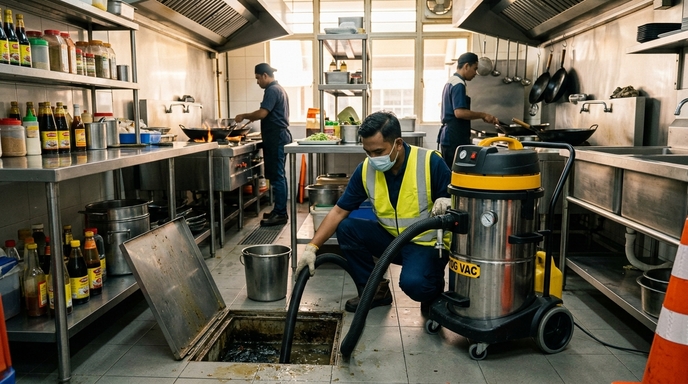
Commercial Grease Trap Maintenance: Legal Compliance and Best Practices in Malaysia
For food service operators across Malaysia—from restaurants and cafes to hotels and food courts—grease trap maintenance is not merely a plumbing concern. It is a legal obligation with direct implications for business licensing, environmental compliance, and operational continuity.
Fats, oils, and grease (FOG) discharged into public sewerage systems remain one of the leading causes of pipe blockages and pollution in Malaysian waterways . When grease traps are neglected, the consequences extend far beyond foul odors and slow drains. Operators risk penalties, license renewal complications, and in severe cases, business disruption from sewer overflows and emergency interventions.
Understanding what the law requires—and what best practices look like in practice—is essential for every commercial kitchen in Malaysia.
What Is a Commercial Grease Trap?
A grease trap, or perangkap minyak, is a device designed to intercept and separate fats, oils, and grease from wastewater before it enters the sewerage system or septic tank . For commercial food premises, these systems are typically larger and more sophisticated than residential units, capable of handling the higher volumes of FOG generated by daily cooking and dishwashing operations.
The fundamental principle is straightforward: FOG is lighter than water. When wastewater flows into the trap, grease rises to the surface while solids settle at the bottom. The relatively clear water in the middle layer flows out to the sewer. Over time, accumulated grease and solids must be removed—this is where maintenance becomes critical.
Why Grease Trap Compliance Is a Legal Requirement in Malaysia
The legal framework governing grease trap installation and maintenance in Malaysia operates at multiple levels.
Licensing Condition Under Local Authorities
Since 2005, the National Council for Local Government mandated that all food premises within local authority (PBT) areas must install, maintain, and desludge grease trap systems as a condition for obtaining or renewing their business license . This requirement applies to the entire range of food-related businesses: restaurants, cafes, food courts, hotels, and institutional kitchens.
Discharge Prohibition Under SPAN
The National Water Services Commission (SPAN) has explicitly reminded business owners that discharging effluent into public sewerage systems is prohibited under Section 61 of the Water Services Industry Act 2006 . Non-compliance can result in enforcement action.
Solid Waste Management Act Implications
Under Act 672 (Solid Waste and Public Cleansing Management Act), illegal disposal of grease trap waste carries severe penalties. Recent industry guidance indicates that violations can result in fines of up to RM 10 million . This underscores the seriousness with which Malaysian authorities view improper FOG disposal.
What Causes Grease Trap Compliance Failures?
Despite clear legal requirements, enforcement actions across Malaysian states reveal recurring patterns of non-compliance.
In a recent joint enforcement operation in Seberang Perai, authorities issued compounds to food premises found without proper grease traps or failing to maintain existing systems. Inspections revealed grease-laden wastewater flowing directly into public drains, with sewer manholes clogged by accumulated oil, sludge, and debris—evidence of prolonged neglect .
The Global Environment Centre has identified a fundamental weakness in the regulatory approach: the existing law primarily requires installation for licensing purposes but does not specify sufficient details regarding trap size, maintenance schedules, or cleaning procedures . This creates a compliance gap where operators may install a grease trap solely to satisfy licensing requirements, then neglect it entirely thereafter.
Recommended Grease Trap Cleaning Frequency in Malaysia
The correct cleaning frequency depends on several factors: the scale of operations, type of food prepared, operating hours, and the capacity of the installed trap.
Industry guidance for Malaysian food premises indicates that high-traffic commercial kitchens—restaurants, cafes, and hotels—may require cleaning monthly or even more frequently . The widely accepted operational threshold is the “25% rule”: when grease and solids occupy more than 25% of the trap’s capacity, efficiency drops significantly and the trap begins to discharge FOG into the sewer system .
For commercial operations, relying on a fixed calendar schedule alone is insufficient. The trap should be inspected regularly, and cleaning should be triggered by actual accumulation levels rather than arbitrary timeframes.
What Proper Commercial Grease Trap Maintenance Involves
Effective maintenance extends beyond simply pumping out the trap.
Complete Evacuation
Professional services perform a total evacuation of FOG, wastewater, and solid food waste from the trap . Partial cleaning—skimming only the visible grease layer—leaves settled solids that reduce effective capacity and accelerate future accumulation.
Pipeline Cleaning
High-pressure hydro-jetting of inlet and outlet pipelines removes hardened grease deposits that can cause backups during peak service hours . This step is often overlooked but is essential for maintaining full system function.
Proper Waste Disposal
Collected grease trap waste must be disposed of through licensed channels. Indah Water Konsortium (IWK) offers desludging services for food premises operators, providing a compliant disposal pathway . Documentation of proper disposal is increasingly important for demonstrating compliance during inspections.
Record Keeping
Maintaining detailed maintenance records—including dates, service providers, volume removed, and disposal documentation—is now explicitly required for license renewal in many jurisdictions . These records also serve as valuable evidence during any enforcement inquiry.
The Consequences of Neglect: Sewer Blockages and Fatbergs
The consequences of inadequate grease trap maintenance extend into public infrastructure, creating costs and disruptions that affect entire communities.
When FOG enters the sewer system, it combines with non-biodegradable solid matter to form fatbergs—large, congealed masses that reduce sewer capacity and ultimately cause blockages . Restaurant grease has been identified as the primary cause of sewer pipe overflow by IWK.
These blockages contribute to flash flooding when storm drains cannot function properly, as has been observed in Malaysian cities where food premises cluster . The environmental impact extends to river pollution, with the Department of Environment identifying food premises as a major contributor to water quality degradation.
Best Practices for Commercial FOG Management
Beyond meeting minimum legal requirements, proactive FOG management delivers operational and reputational benefits.
Train staff in proper practices.
Schedule regular inspections and cleaning. E
Consider biological augmentation.
Address both grease traps and kitchen exhaust ducts.
When Should Commercial Operators Schedule Maintenance?
The following situations warrant immediate attention or assessment:
- When the trap reaches 25% capacity in grease and solids
- When slow drainage or foul odors are detected in kitchen areas
- Before license renewal applications (documentation of prior maintenance is required)
- After periods of high-volume operation (holidays, events, seasonal peaks)
- When changing menu items toward higher-fat cooking methods
For most commercial operations in Malaysia, a monthly cleaning schedule serves as a reasonable baseline, adjusted upward or downward based on actual accumulation rates observed through regular inspection.
Choosing a Professional Grease Trap Maintenance Provider
When selecting a service provider, commercial operators should verify:
- Licensing and compliance with local authority requirements
- Proper disposal documentation for collected waste
- Availability of emergency response for overflow situations
- Experience with commercial-scale systems and local regulations
- Comprehensive service including pipeline cleaning, not just pump-out
Working with a compliant service provider protects your business from the liability associated with improper disposal by contractors.
Conclusion
Commercial grease trap maintenance is a legal obligation, an operational necessity, and an environmental responsibility for every food premises operator in Malaysia. The regulatory landscape is clear: installation is required for licensing, maintenance records are increasingly demanded for renewal, and improper disposal carries severe penalties.
Beyond compliance, regular maintenance protects your business from the costly disruptions of sewer blockages, foul odors, and emergency repairs during peak service hours. It safeguards public infrastructure from fatbergs and flooding, and it demonstrates responsible environmental stewardship—increasingly valued by customers, landlords, and regulators alike.
Whether you operate a single restaurant, a chain of cafes, a hotel kitchen, or a food court, establishing a documented maintenance schedule with a qualified service provider is one of the most cost-effective investments you can make. Prevention is consistently cheaper than enforcement, remediation, or reputational damage.
FAQs
1. Is grease trap installation mandatory for all food premises in Malaysia?
Yes. Since 2005, all food premises within local authority areas are required to install grease traps as a condition for business license issuance and renewal . This applies to restaurants, cafes, hotels, food courts, and institutional kitchens.
2. How often should a commercial grease trap be cleaned in Malaysia?
Cleaning frequency depends on operational volume and trap capacity. For high-traffic commercial kitchens, monthly cleaning or more frequent service is typically required. The operational rule is to clean when grease and solids reach 25% of trap capacity, as efficiency drops significantly beyond this threshold .
3. What documentation is required for license renewal?
Recent KPKT guidelines require maintenance records covering the three-month period preceding the renewal application, along with completed inspection forms . Maintaining thorough documentation is essential for demonstrating compliance.
4. What are the penalties for non-compliance?
Penalties vary by jurisdiction and enforcement action. Local authorities can issue compounds under local government by-laws, while SPAN can enforce discharge prohibitions under the Water Services Industry Act 2006 . Under Act 672, illegal FOG disposal can result in penalties up to RM 10 million .
5. Can a grease trap be maintained by kitchen staff?
While kitchen staff can perform basic checks and remove surface grease, proper maintenance requires professional pump-out, pipeline cleaning, and compliant waste disposal. License renewal increasingly requires documented evidence of professional maintenance. A qualified service provider ensures both compliance and proper waste handling.