
Hydro Jetting vs. Drain Snaking: Which Drain Cleaning Method Is Best?
When a drain clogs or slows to a trickle, property owners face a common dilemma: should you use traditional snaking methods or invest in hydro jetting? Both approaches can restore flow, but they work in fundamentally different ways and are suited to distinct types of plumbing problems.
Understanding the differences between these methods helps you make an informed decision, avoid unnecessary expenses, and prevent recurring clogs that plague many properties. This guide examines hydro jetting and drain snaking techniques so you can choose the right solution for your situation.
What Is Drain Snaking?
Drain snaking is a traditional mechanical method using physical tools to clear blockages. A flexible metal cable is inserted into the drain to reach and break up obstructions.
Professional plumbers use power augers (rooter machines) for deeper, stubborn clogs, sometimes with built-in clog detectors and cameras. The method also includes plunging, which uses suction and pressure to dislodge simple clogs near drain openings.
- Uses a flexible metal cable inserted into the drain to reach and clear obstructions
- Power augers, also called rooter machines, handle deeper and more stubborn clogs
- Some motorized tools include built-in diagnostic features like clog detectors and video cameras
- Plunging uses suction and pressure to dislodge simple clogs near drain openings
What Is Hydro Jetting?
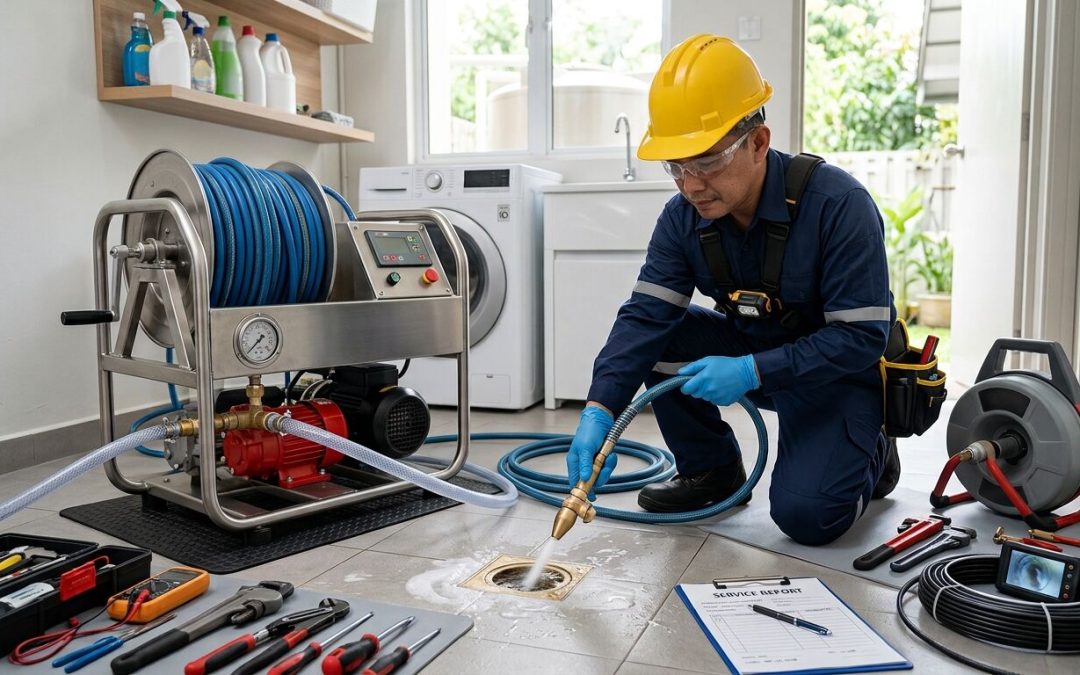
Hydro jetting is a more advanced method using highly pressurized water (3,000–4,000 PSI) through specialized nozzles to blast away blockages and clean pipe walls.
A custom nozzle enters the line, shooting water in multiple directions. Forward jets bore through obstructions while rear jets scour pipe walls, driving the hose forward and removing buildup. This doesn’t just clear a path—it restores the pipe to near-original condition by stripping grease, scale, mineral deposits, and debris from the entire interior surface.
- Uses highly pressurized water, typically ranging from 3,000 to 4,000 PSI
- Directs water through specialized nozzles to blast away blockages
- Forward jets bore through obstructions while rear jets scour pipe walls
- Restores pipes to near-original condition by stripping away grease, scale, mineral deposits, and debris
- Cleans the entire interior surface, not just a passage through the clog
How Does Drain Snaking Work?
Drain snaking uses a long, flexible metal cable with a cutting head or corkscrew tip. The plumber feeds it into the drain until it reaches the clog, then rotates it to break through or grab the obstruction.
The twisting action breaks up the blockage or hooks it for removal. Simple blockages near the drain opening often clear in minutes.
However, snaking creates a hole through the clog rather than removing the entire buildup. Grease, soap scum, and mineral deposits remain coating pipe walls—which is why clogs often return within months.
- Plumber feeds the cable into the drain until it reaches the clog
- Rotating action breaks through or grabs the obstruction
- Twisting motion either breaks up the blockage or hooks onto it for removal
- Simple blockages near the drain opening often clear in minutes
- Creates a hole through the clog rather than removing the entire buildup
- Grease, soap scum, and mineral deposits often remain coating the pipe walls
- Clogs can return within months because buildup remains
Key Differences Between Hydro Jetting and Drain Snaking
The fundamental difference between these methods lies in their approach and thoroughness. Snaking mechanically punches through a blockage, while hydro jetting hydraulically scours the entire pipe interior.
Hydro Jetting
- Hydraulically scours the entire pipe interior
- Removes all buildup from pipe walls
- Requires pipes in good condition
- Provides longer-lasting results
- Requires higher initial investment
Drain Snaking
- Mechanically punches through a blockage
- Clears only the immediate obstruction
- Works on most pipes including older systems
- May need repeat visits for recurring clogs
- Has lower initial cost
When Drain Snaking Is the Right Choice
Drain snaking is ideal for older properties with fragile plumbing—pre-1960 buildings often have clay or early cast iron pipes that could crack under high pressure. It works best for simple, localized clogs affecting a single fixture—one sink backing up or a toilet not flushing. It’s also cost-effective, typically cheaper than hydro jetting.
- Older properties with fragile plumbing systems benefit from gentler mechanical approach
- Buildings constructed before 1960 often have clay or early cast iron pipes
- These pipes could crack under high pressure, making snaking safer
- Simple, localized clogs affecting a single fixture respond well to snaking
- One sink backing up or a toilet not flushing properly can be resolved without significant expense
- Cost-effective for budget-conscious property owners
- Professional drain snaking typically costs less than hydro jetting
- Hair clogs in bathroom drains clear easily with snaking
- Food particle blockages in kitchen lines respond well
- Toilet clogs from paper products are ideal for snaking
When Hydro Jetting Delivers Superior Results
Hydro jetting is better for recurring clogs, heavy grease, or main sewer issues. If drains keep clogging after snaking, buildup remains on pipe walls that mechanical methods can’t reach.
Commercial kitchens benefit most—hydro jetting is often the only way to fully clear heavy FOG. Tree roots also respond better: jets cut through and flush debris out completely. Hard water scale narrows pipes—snaking can’t fix it, but hydro jetting can.
- Drains that repeatedly clog despite previous snaking indicate buildup remains on pipe walls
- Mechanical methods cannot address stubborn wall buildup
- Commercial kitchens and restaurants benefit from hydro jetting
- These facilities accumulate large amounts of fats, oils, and grease
- Traditional methods cannot effectively remove heavy grease deposits
- Hydro jetting is often the only way to fully clear commercial kitchen drain lines
- Tree root intrusion responds better to hydro jetting
- High-pressure jets cut through roots and flush debris completely out of the system
- Snaking may only cut through roots without removing them
- Properties with hard water conditions benefit significantly from hydro jetting
- Mineral scale accumulation gradually narrows pipe diameter and restricts flow
- Snaking cannot address scale buildup but hydro jetting completely resolves it
Cost Comparison: Short-Term Savings vs. Long-Term Value
Drain snaking costs less per visit—attractive for immediate, simple clogs. But if clogs recur multiple times a year, repeated snaking often costs more than one hydro jetting service. More importantly, recurring clogs signal an underlying problem snaking can’t solve.
Hydro jetting costs more upfront but lasts far longer. Because it thoroughly cleans pipe walls, service intervals extend significantly—often three to four times longer than snaking.
For commercial properties, hydro jetting delivers better value by preventing emergency shutdowns and maintaining health regulation compliance.
- Drain snaking costs less per visit
- Attractive for immediate, simple clogs
- When clogs recur multiple times per year, cumulative cost of repeated snaking often exceeds a single hydro jetting service
- Recurring clogs indicate an underlying problem that snaking cannot solve
- Hydro jetting represents a higher upfront investment
- Provides longer-lasting results because it thoroughly cleans pipe walls
- Interval between service calls extends significantly, often three to four times longer than snaking
- For commercial properties, hydro jetting often delivers better value
- Prevents emergency shutdowns and maintains compliance with health regulations
Combining Methods for Optimal Results
Sometimes plumbers use both methods together. Snaking opens a completely blocked line to restore immediate flow, then hydro jetting thoroughly cleans the pipe to reduce future problems. This combined approach is useful when a line is fully blocked and needs initial clearing before hydro jetting equipment can be deployed.
- Snaking can open a blocked line to restore immediate flow
- Followed by hydro jetting to thoroughly clean the pipe
- Reduces the likelihood of future problems
- Particularly useful when a line is completely blocked
- Initial clearing allows hydro jetting equipment to be properly deployed
Conclusion
Both hydro jetting and drain snaking play important roles in modern plumbing maintenance: snaking remains an excellent choice for simple clogs, older pipes, and situations requiring quick, affordable solutions, while hydro jetting provides superior results for grease buildup, recurring clogs, and comprehensive pipe cleaning. The key to choosing correctly lies in professional assessment—a camera inspection identifies the exact cause, location, and severity of the blockage while also revealing pipe condition, allowing plumbers to recommend the method that solves the problem effectively without risking damage. Whether dealing with a simple bathroom clog or a commercial kitchen’s persistent drainage issues, understanding these methods helps property owners make informed decisions that protect their plumbing systems and save money over time.
FAQs
1. What is the main difference between hydro jetting and drain snaking?
Drain snaking uses a mechanical cable to break through or grab a clog, while hydro jetting uses high-pressure water to scour the entire pipe interior. Snaking creates a passage through the blockage; hydro jetting removes all buildup from pipe walls.
2. Is hydro jetting safe for all types of pipes?
Hydro jetting is safe for most pipes when performed by professionals who adjust pressure based on pipe material and condition. However, it’s not recommended for severely deteriorated, cracked, or fragile pipes. A camera inspection determines suitability before proceeding.
3. When should I choose drain snaking over hydro jetting?
Choose drain snaking for simple, first-time clogs in a single fixture, when pipes are older or fragile, or when budget is a primary concern. Snaking is ideal for hair clogs, soap scum, and minor obstructions.
4. How long do hydro jetting results typically last?
Hydro jetting results typically last significantly longer than snaking, often one to three years depending on usage, water conditions, and pipe material. Because it removes buildup from pipe walls, clogs take far longer to recur.
5. Can hydro jetting remove tree roots from sewer lines?
Yes, hydro jetting can cut through and flush out tree root intrusions. However, it addresses the symptom rather than the cause. The entry point where roots penetrated remains open. Combining hydro jetting with pipe repair or lining permanently seals entry points.